A Church Divided
In 1819, the Congregationalists of Canaan formed a society to promote worship and fellowship. By 1828, the society had grown strong enough to erect a church building “on the brow of a bleak hill, where the air currents are always strong.”
These men and women were likely somewhat unusual for their time. For one thing, the church they built (Canaan’s Old North Church) is in an architectural style called Gothic Revival. The most obvious Gothic elements are the pointed tops of our church windows. This is a style of architecture that didn’t become prevalent in the United States for many years to follow. Canaan’s Old North Church is likely the first or second Gothic Revival church in New Hampshire. Alas, we can find no records of how this happened or who designed the church.
These men and women of the congregation were also somewhat ahead of their time in their politics. The abolitionist movement in the United States is said to have started in 1831 with the publication of The Liberator. Five years later, Canaan is reported to have had 70 abolitionists, more than almost any other town in New Hampshire, many of them members of our church.
In 1834, these abolitionists established Noyes Academy, the first co-ed school in America to offer admission to Black students. Samuel Noyes, for whom the school was named, was a founding member of our church. Other church members were opposed to the school, understanding that to offer education to Black students would provoke the Southern states who threatened to dissolve the new country every time the North moved against slavery. In 1861, the South made good on those threats. They lost the Civil War in 1865.
It was not hard to move citizens against the school. Black people were unfamiliar and the men and women of 1835 wanted to do business with the South. Many Southerners were welcome and was wealthy and trading manufactured goods with them was a large source of local income. And, like today, it was all too easy to conflate wealth with virtue. Layer onto this a very personal grudge one church founder (Jacob Trussell) had with three of the school’s founders (Nathanial Currier, George Kimball and Hubbard Harris – also church members) over their political embrace of Anti-Masonry and you have the recipe for conflict.
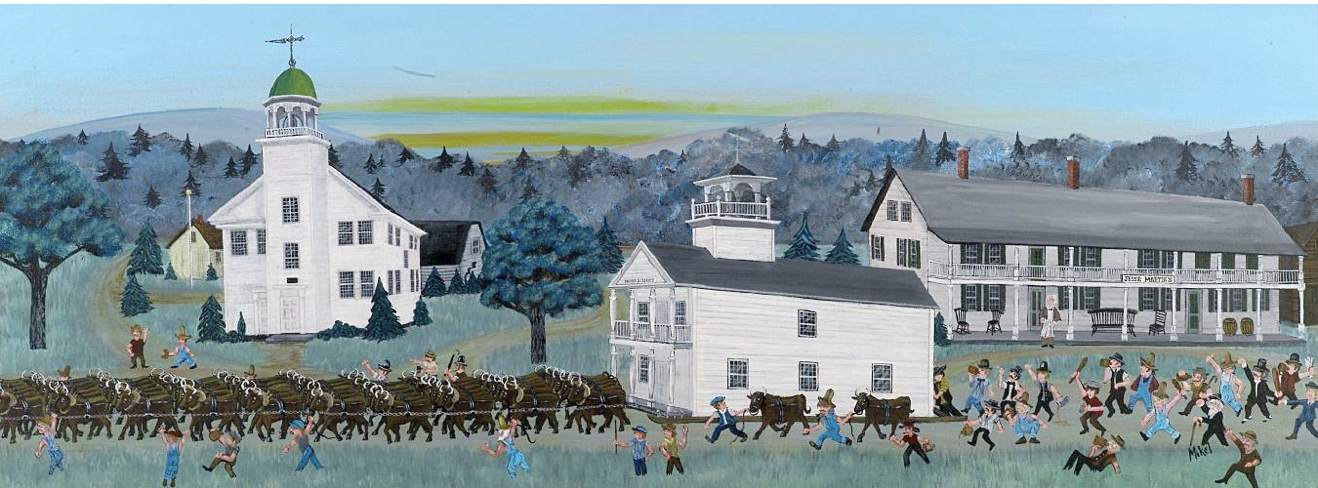
Trussell and his followers whipped the local population into a riotous frenzy; they tore the school, which was located on the still-empty plot of ground just south of the church, from its foundations, dragged it nearly a mile down the street and dumped it in front of the Meeting House.
Trussell was excommunicated from our church over his antics and readmitted in 1854, reportedly unrepentant.
The building that housed Noyes Academy burned in 1839 and was rebuilt as a replica. That replica stands today at the other end of Canaan Street. It houses the Historical Museum. Church members tried to open a second school in the building, naming it Canaan Union Academy; its name stressed the virtue of holding the Union together. That school failed and financial chicanery ensued.
Lest we paint our forebears as irredeemable scoundrels and racists, it should be noted that thirty years after the violence attending Noyes Academy, the sons and grandsons of those men laid their lives on the line to end slavery. 1835 was very early in our country’s understanding of the evil that was slavery. It took the aboli- tionists movement another twenty-five years to persuade us that evil was still evil, even dressed in glittering wealth.
Our church never recovered from this early controversy. In an 1884 biography of Amos Foster, our minister from 1825 until 1833, the Old North Church is referred to as “extinct.” Moses Gerould, minister from 1856 until 1863, in his autobiogra- phy, described his time in Canaan as a failure and blamed this on the divisions that still existed among the church members stemming from the violence attending the destruction of Noyes Academy.
As Wallace notes in his History of Canaan, “No steps were taken by the dominant party [the men who destroyed Noyes] to conciliate the large number of citizens who were aggrieved; no kind words were spoken, nor did anyone propose any method to harmonize the antagonisms: and there the two nearly equal hostile factions stood, making faces at each other, the one pointing to that building [the Academy building] as a monument of acts of aggression unatoned for and the other flinging back contemptuous epithets ad libitum.”
Perhaps as a result of these contentions, our church remains today much as it was built, with its box pews still bearing the names of the founders whose differences destroyed it. There is still no electricity and no heat. And there is still a “Negro pew” upstairs, built for the town’s two Black citizens neither of whom used it, sitting instead with the rest of the congregation.
Two centuries ago, our church was part of the drama that swept our country. It was animated by the passions of its time, formative events in our nation’s history. To attend our annual service during Canaan’s Old Home Days is to almost feel the lives of those who built this church and the lives of those who sustained it for over two centuries. They still animate the old place even as their bones lie peacefully in the cemetery across the street.